

For many HOA board members, irrigation is one of those community systems that can quietly fade into the background — until a water bill jumps, a leak appears, landscaping begins to struggle or residents start asking why sprinklers are running after a rainstorm.
John O’Donnell has spent much of his career focused on what happens before those problems become obvious.
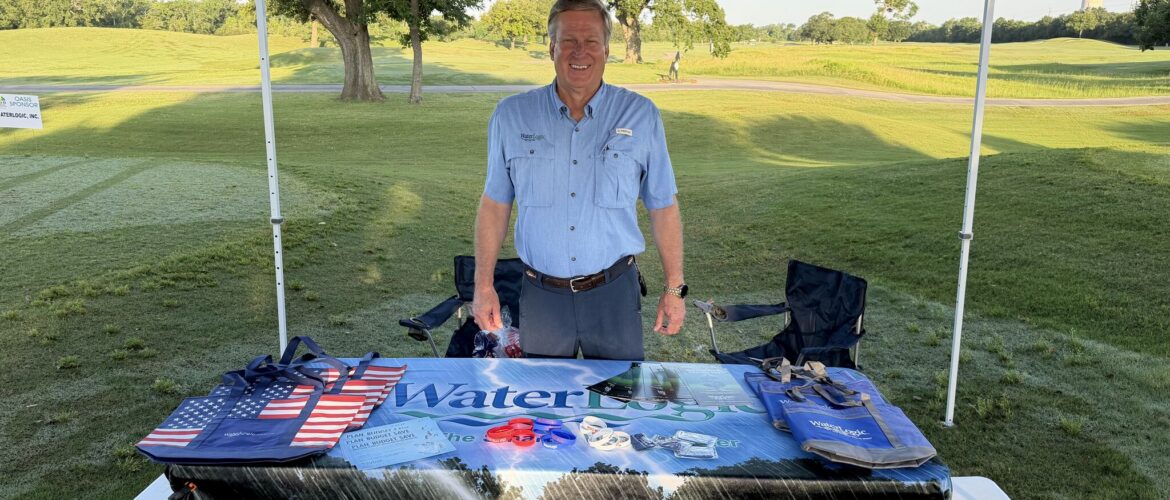
As Vice President of Technology for WaterLogic Texas, O’Donnell brings more than three decades of irrigation industry experience to a field that is becoming increasingly important for Houston-area homeowners associations. His work sits at the intersection of technology, landscape health, water conservation and HOA operating costs, helping communities make more informed decisions about when irrigation systems should run and how much water landscapes actually need.
His path into the industry, however, began long before smart controllers, cellular communications and remote flow monitoring entered the conversation.
A Houston Career That Started Across the Street
O’Donnell is a native Houstonian who grew up on the west side of the city. When he was 14, a neighbor who had started a sprinkler company in 1968 gave him an opportunity to work alongside the family. At the time, there were only a handful of sprinkler companies operating in Houston.
What started as a teenage summer job became the foundation for a career.
“I started working with him and boys when I was 14 years old. I had no idea it would become my lifelong work. He mentored me not only in the irrigation business, but also in life.”
O’Donnell continued working summers before returning full-time after graduating from Texas A&M University with a degree in Mechanical Engineering.
Initially, he imagined engineering might lead him somewhere else. But fluid mechanics and hydraulics interested him, and he quickly recognized that a career combining technical knowledge with sales, engineering and face-to-face interaction suited him better than spending his working life behind a desk.
An early assignment helped push him further outside his comfort zone. Shortly after college, his boss recommended him to teach an irrigation class at Houston Community College. At just 22, O’Donnell found himself teaching people twice his age. He had the technical foundation, but learning to communicate that knowledge in front of a classroom became an important part of his professional development.
That role as an educator never entirely disappeared. O’Donnell has now taught irrigation classes for 44 years, helping students prepare for the Texas state irrigator’s exam.
Why Water Management Matters to an HOA’s Bottom Line
O’Donnell’s career eventually included sales and landscape management before leading to WaterLogic Texas, where he has spent more than two decades.
For HOA boards trying to control association expenses, his view of irrigation is straightforward: water management is not simply an environmental consideration. It is also a financial one.
“WaterLogic is one of the few companies that puts money back in the pocket of our clients. We prevent the waste of water that occurs while we sleep at night when most sprinkler systems operate.”
That nighttime schedule is significant because much of an HOA community’s irrigation activity happens when board members, residents and community managers are not watching.
WaterLogic Texas says it has saved clients more than 11.9 billion gallons of water over the past 24 years, representing more than $62 million in estimated client savings based on water rates.
The company’s approach is designed to prevent unnecessary irrigation by adjusting watering according to conditions such as rainfall, cloud cover, cooler temperatures and humidity rather than relying entirely on a predetermined calendar.
For an HOA responsible for entrances, parks, common areas, esplanades and other maintained landscaping, the practical question becomes less about whether sprinklers work and more about whether they are operating when the landscape actually needs them.
Smart Irrigation Moves Beyond a Monday-Wednesday-Friday Schedule
Many conventional irrigation systems operate according to a fixed schedule. A controller might be programmed to run Monday, Wednesday and Friday whether conditions have changed or not.
WaterLogic Texas uses controllers that operate dynamically, adjusting irrigation according to current conditions and plant needs. If sufficient moisture remains in the soil following rainfall, for example, watering can be skipped.
For O’Donnell, that distinction gets to the heart of a common misconception about conservation.
“Water management is not restricting water to the landscape. It is about applying the right amount of water at the right time to the plant material. It is managing runoff and not wasting water, therefore wasting money for the community.”
The goal, in other words, is not simply to use less water regardless of the consequences. It is to use water more deliberately so landscapes receive what they need without routinely paying for water that provides little or no additional benefit.
That can matter increasingly as HOA boards balance landscape expectations with rising community operating expenses and long-term pressure on Texas water supplies.
The Landscaper and Water Manager Have Different Jobs
O’Donnell also sees an opportunity for HOA boards to better understand the distinction between landscape maintenance and irrigation water management.
A landscape contractor may maintain plants, address weeds and repair irrigation components. A water manager focuses on when the irrigation system operates and how long individual zones should run.
Those responsibilities overlap, but they are not identical.
O’Donnell compares the relationship to working with a personal trainer while also paying attention to nutrition: both contribute to the health of the same body, but each addresses it from a different perspective.
When landscape professionals and water managers communicate, he said, communities are better positioned to protect both appearance and resources. Information about dry areas, plant stress, irrigation repairs or changing conditions can help guide watering decisions, while better water management can help prevent overwatering, runoff and unnecessary expenses.
That coordination may also give HOA boards a more complete picture when evaluating why particular areas of a property are struggling rather than assuming every landscape problem requires additional watering.
Technology Is Making Irrigation Problems Easier to Find
The tools available for HOA irrigation management have changed dramatically during O’Donnell’s career.
When he first joined WaterLogic Texas, the company used pager technology to transmit weather information to irrigation controllers. Controllers could receive data and adjust programming, but communication largely moved in one direction.
Cellular technology has changed that relationship.
Modern systems can transmit information back to WaterLogic Texas, helping identify problems such as an open circuit caused by a cut wire or a shorted solenoid. Systems equipped with flow-sensing technology can detect unusually high water flow, shut down a leak and send an alert so the landscape company can investigate.
That creates an opportunity to address irrigation failures before visible landscape damage becomes the first indication something has gone wrong.
The continuing evolution is one reason O’Donnell believes staying curious remains important regardless of how many years someone has spent in a profession.
“I think the most important lesson is to never stop learning. We all thought that when we graduated from school that we had finished having to learn. That was just the beginning.”
New controllers, communication methods, flow-monitoring technology and water-management strategies have continually reshaped the industry. O’Donnell expects that evolution to continue as water costs rise and population growth places additional pressure on existing water supplies.
What HOA Boards Should Watch in the Years Ahead
For Houston-area HOA boards, irrigation technology may increasingly move from an optional efficiency measure toward a basic part of responsible community infrastructure planning.
O’Donnell believes the industry will have to become more effective at managing water or face greater restrictions from government entities. Other communities in Texas and across the country have already experienced limitations on outdoor watering when water supplies become strained.
He expects smart irrigation controllers capable of responding to changing weather conditions to become increasingly common.
Reclaimed water is another area drawing interest. According to O’Donnell, more communities and municipal utility districts are exploring reclaimed water as an irrigation source that can reduce reliance on potable water. Advances in measuring flow and managing irrigation remotely could create additional opportunities for communities to better understand exactly where their water is going.
For WaterLogic Texas, O’Donnell believes staying on the leading edge of those changes will remain central to the company’s role.
He credits the company’s people and the irrigation management expertise developed across the organization over more than two decades. From his perspective, WaterLogic’s work has one central purpose: helping clients save water and, in turn, save money.
A Long-Term View for HOA Leadership
Technology may provide HOA boards with more data than ever, but O’Donnell’s advice to community leaders ultimately has less to do with controllers and more to do with perspective.
HOA boards regularly make decisions involving budgets, landscaping, infrastructure, reserve planning and community appearance. Those decisions can solve an immediate problem while still creating a different challenge several years down the road.
That makes long-term thinking especially important.
“My best advice would be to have a long term vision of where you want the community to go. Many times, decisions can be made in the short term that will hurt the community in the long run.”
It is a philosophy that mirrors O’Donnell’s own career: the teenager helping a neighbor with sprinkler systems could not have anticipated decades spent teaching irrigation, adapting to new technology and helping communities rethink how they use water.
Outside work, family and grandchildren remain important to him — particularly when family time happens to overlap with Fighting Texas Aggie Football. Professionally, he continues to find motivation in enjoying the work, the people around him and the constant opportunity to learn something new.
His outlook is summarized by another lesson he has carried throughout his career: life is less about what happens to a person than how that person responds to it.
For HOA boards across Greater Houston, that same mindset may prove useful as water management becomes a larger part of protecting community budgets, landscapes and resources for the residents who will call those neighborhoods home years from now.
HOA Connect Houston will continue spotlighting the professionals, resources and ideas helping Houston-area HOA board members make informed decisions for the communities they serve.